Written by Sheryl Joy Ganal, Senior Instructor at The Moving Body
If there’s one condition I see more than almost any other in the studio, it’s lower back pain.
With a background in physiotherapy and more than ten years of teaching Pilates, I’ve worked with clients of all ages—from office workers and new mothers to older adults and active individuals recovering from injury. One thing I’ve learned is that lower back pain is rarely caused by one single problem. More often, it’s a combination of how we move, how we sit, how strong our bodies are, and how we respond when pain starts.
Many people arrive expecting me to give them a list of “back pain exercises”. Instead, the first thing I do is understand how they move.
That’s because two people with the same complaint can need completely different solutions.
Lower Back Pain Is Common—But It Isn’t Normal
One of the biggest misconceptions I hear is that lower back pain is simply part of getting older.
People often tell me, “I’m getting older, so I suppose this is normal.”
While lower back pain becomes more common as we age, it isn’t something we should simply accept. Pain is your body’s way of telling you that something needs attention. That might mean improving your movement habits, strengthening certain muscles, restoring mobility, or addressing an injury.
Another misconception is that lower back pain only affects older adults.
In reality, I increasingly see younger adults—and even children—developing lower back pain. Long hours studying, prolonged sitting, poor posture, reduced physical activity and limited body awareness all contribute. Lower back pain isn’t an age issue; it’s often a movement issue.
Research reflects this. The World Health Organization identifies lower back pain as the leading cause of disability worldwide, affecting people across all age groups—not just older adults.
Why Does Lower Back Pain Happen?
There isn’t one single cause.
The most common contributors I see include:
- Prolonged sitting
- Poor postural habits
- Reduced physical conditioning
- Weakness in the muscles that support the spine
- Repetitive sports or heavy lifting without adequate preparation
- Age-related changes in the spine
One of the biggest factors is prolonged sitting.
When we sit for hours with a rounded back, our spine stays in a flexed position for much longer than it was designed to. Over time, this can place additional stress on the muscles, ligaments and discs that support the spine.
That doesn’t mean sitting itself is “bad”. It’s spending too long in the same position without enough movement that often becomes the problem.
Not Every Back Pain Is the Same
While I do see the occasional disc-related injury, much of the lower back pain I see is mechanical in nature. People often experience aching, stiffness or fatigue around the back without there necessarily being a serious structural injury.
Understanding the type of pain helps guide the exercise programme.
Muscular pain
Muscular pain is often:
- dull or aching
- associated with muscle fatigue
- localised to one side
- aggravated by overuse or prolonged positions
Disc-related pain
Disc-related pain is often different.
It may feel:
- sharper
- more central in the spine
- associated with tingling or pins and needles
- accompanied by numbness or symptoms travelling into the leg
These are general patterns rather than rules, which is why assessment is so important. Imaging such as an MRI may sometimes be appropriate, but movement assessment remains one of the most valuable tools for understanding how someone is functioning.
Why I Assess Movement Rather Than Posture
One of the questions I’m often asked is whether I spend time analysing someone’s posture.
The answer is yes—but not in the way most people expect.
I don’t simply ask someone to stand still while I observe them.
Instead, I want to see them move.
Movement tells me much more.
During an assessment, I usually look at simple movements such as:
- flexion (bending forwards)
- extension (bending backwards)
- rotating
- side bending
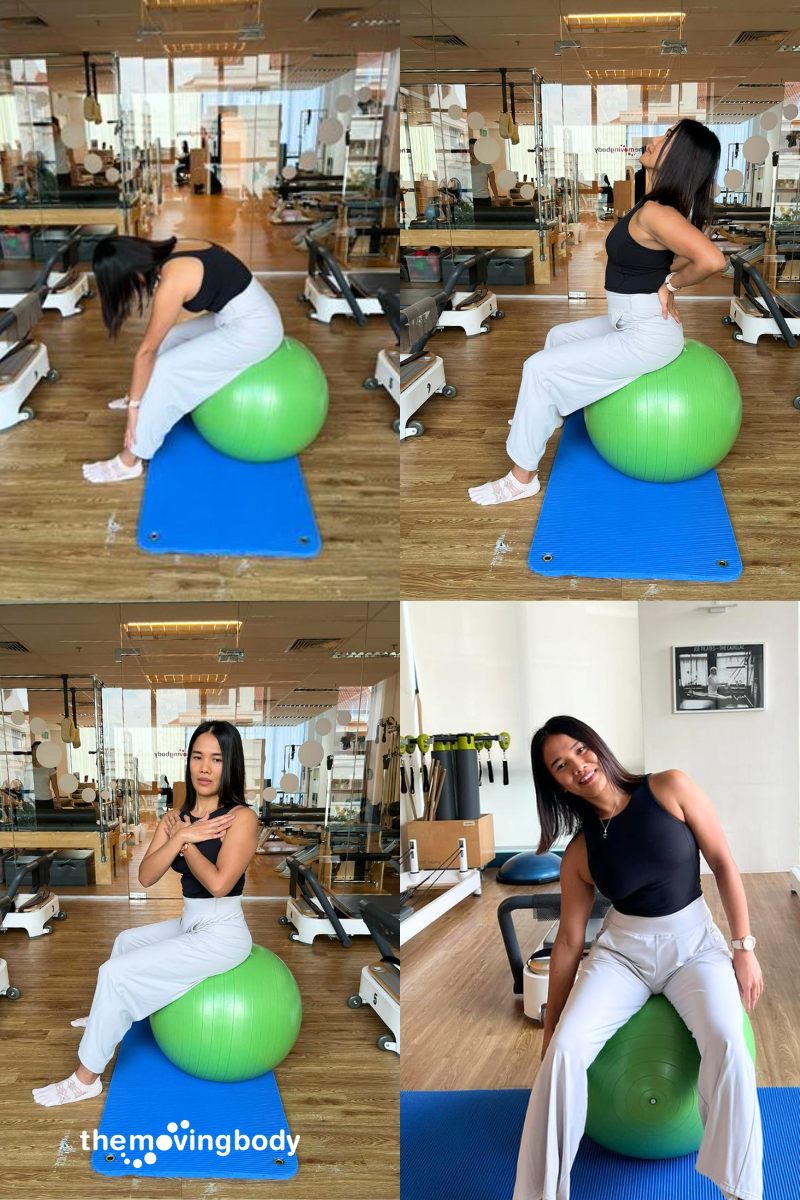
Sheryl demonstrating the four primary spinal movements—flexion, extension, rotation, and side bending—using a gym ball that she uses during an assessment.
These movements help me understand:
- which positions aggravate symptoms
- which positions relieve symptoms
- whether there are mobility restrictions
- how stable the pelvis and spine are
- whether one side is working differently from the other
From there, I can decide whether the priority should be improving mobility, building stability, increasing strength—or a combination of all three.
There isn’t a single formula that works for everyone.
Pilates Is About More Than “Strengthening Your Core”
People often tell me they know they need to strengthen their core.
What they sometimes don’t realise is that the core isn’t just the abdominal muscles.
The muscles around your trunk, pelvis and spine all work together to support movement.
When someone spends years sitting in poor positions or moving with compensation patterns, these muscles often stop working together efficiently. Pilates helps restore that coordination.
That’s why our sessions don’t begin with advanced exercises.
We start by teaching the body how to move well again.
The Exercises I Commonly Start With
Every programme is individual, but there are several exercises I use regularly because they tell me a great deal about how someone moves.
Cat-Cow
Cat-Cow is both an assessment and a mobility exercise.
It helps me observe how someone moves through their spine while gently improving spinal awareness.
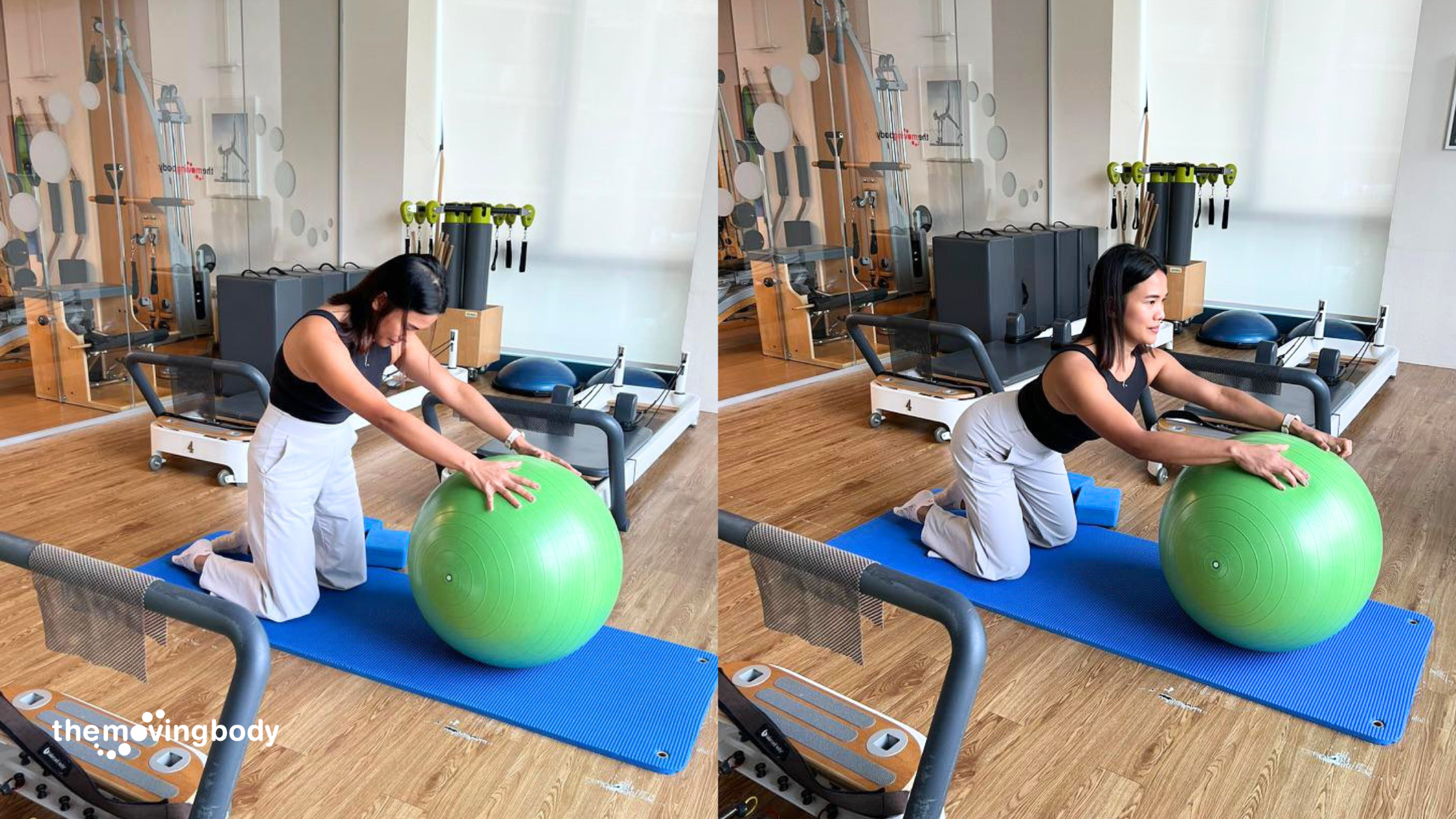
Sheryl demonstrating the Cat-Cow exercise using a gym ball
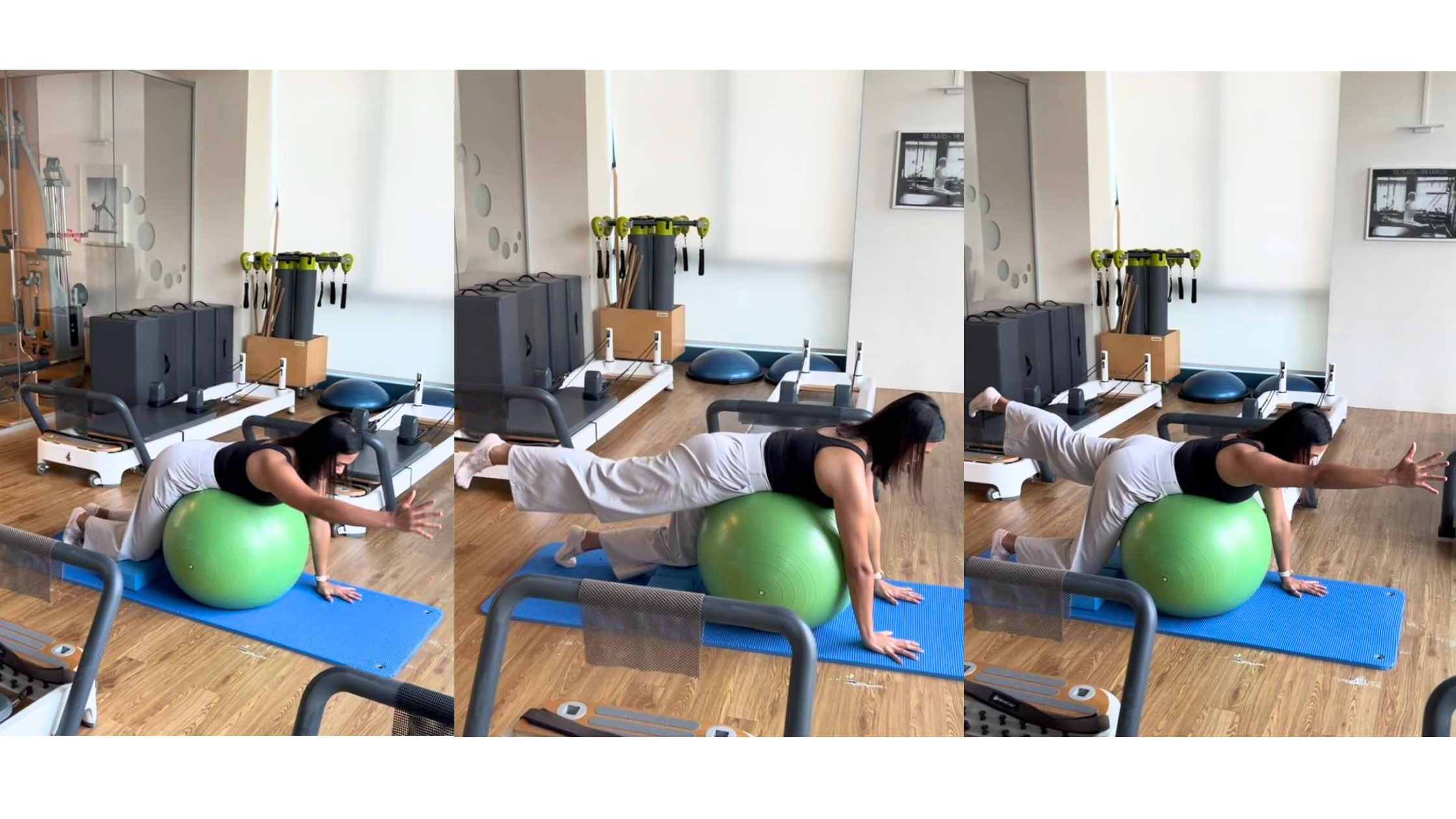
Bird Dog
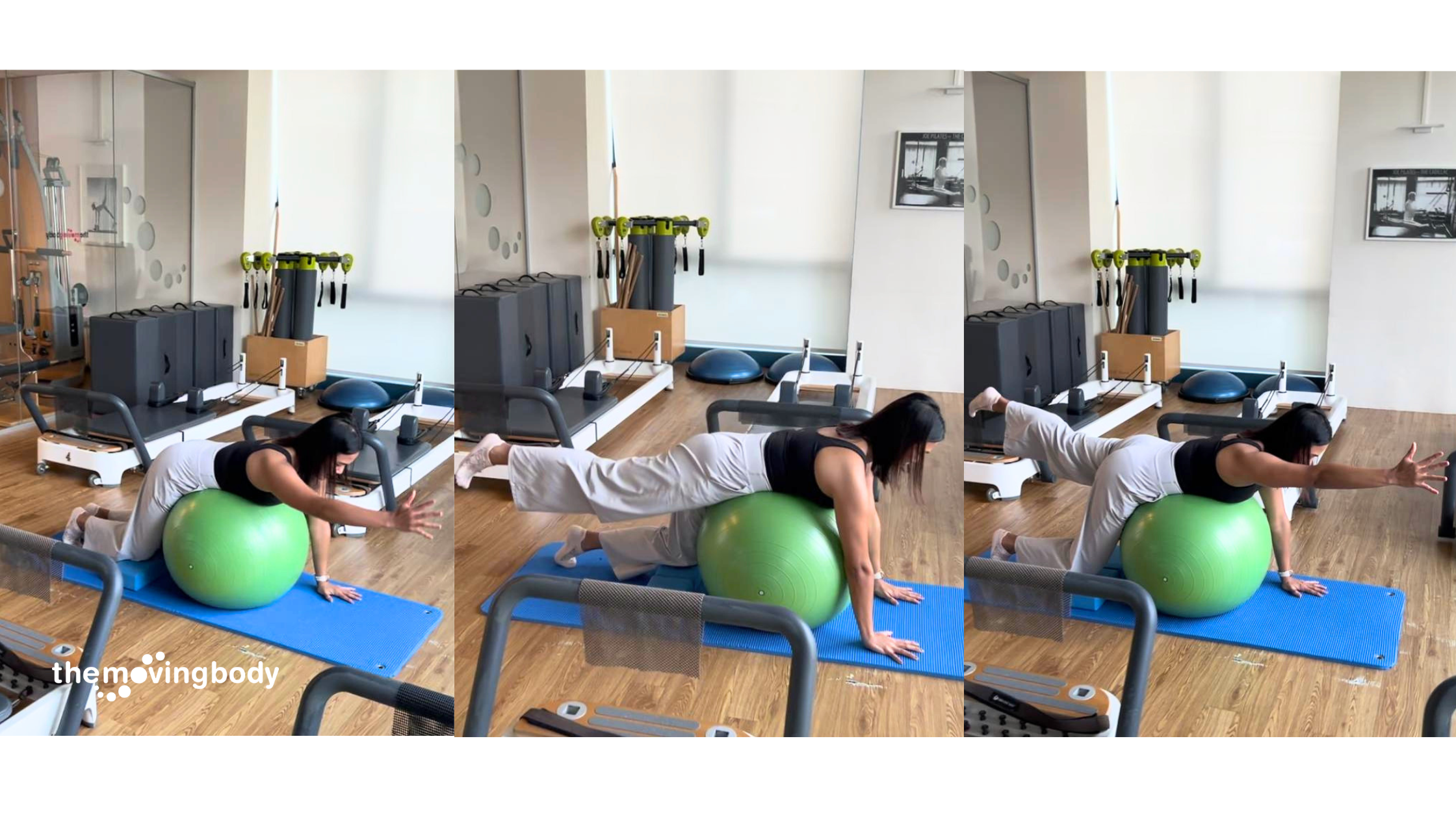
Sheryl demonstrating the Bird Dog.
Bird Dog develops stability. I often progress this exercise gradually—starting with just the arms, then the legs, before combining both. The goal isn’t simply to make the exercise harder. It’s to help the client maintain good control of their pelvis and spine throughout the movement.
Bridge
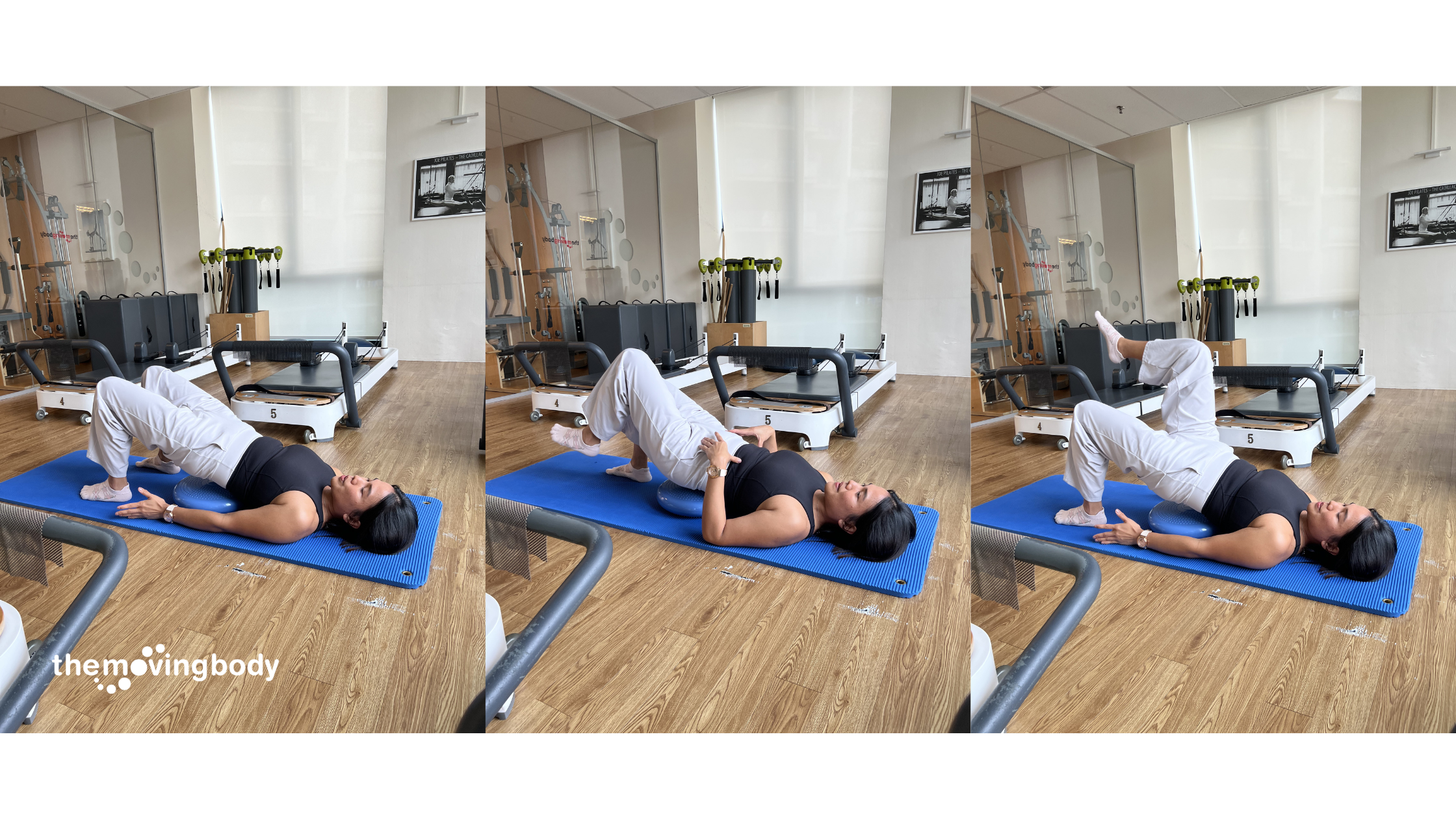
Sheryl demonstrating the Bridge.
Bridges strengthen the gluteal muscles and help clients learn to generate movement from their hips rather than relying excessively on their lower back.
Many clients with lower back pain benefit from stronger hip muscles because they provide better support for the spine during daily activities.
Why I Often Use Props
People who are in pain frequently lose confidence in movement.
Simple props such as balls or cushions provide support and feedback.
Rather than constantly telling clients whether they’re leaning to one side, the prop often lets them feel it themselves.
This helps develop body awareness while making movement feel safer.
When We Progress to Pilates Equipment
Once someone has developed better movement awareness and control, we can begin using Pilates equipment such as the Reformer, Chair or Ladder Barrel.
Each piece of equipment offers different benefits.
On the Reformer, I often work on postural control, hip strength and coordination.
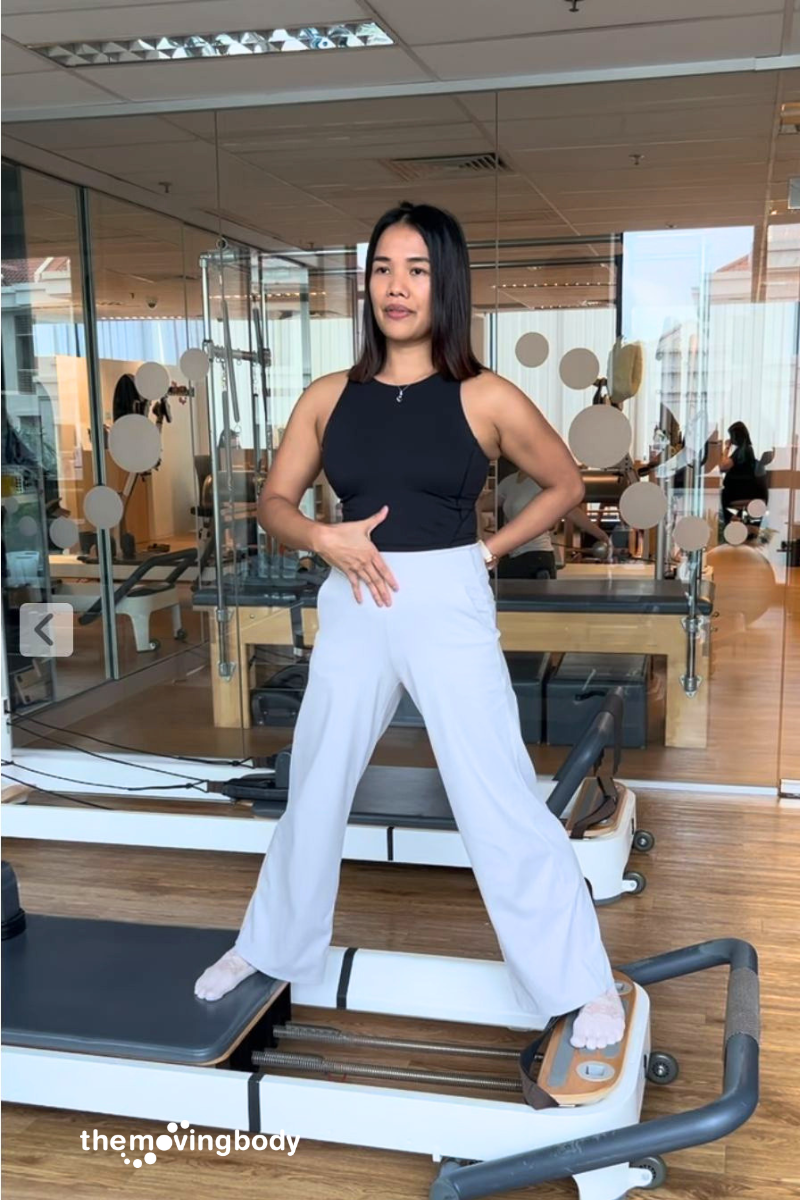
Sheryl on the Reformer
The Chair allows me to challenge balance and single-leg stability.
The Ladder Barrel is particularly useful for mobility and side-bending exercises.
The equipment isn’t simply about making exercises harder. It’s about giving clients different ways to improve strength, stability and movement quality while keeping exercises appropriately supported.
The Biggest Mistake People Make
One of the most common mistakes I see is people copying exercises from social media without understanding why they’re doing them.
A certain exercise may work very well for one person but aggravate someone else’s symptoms.
For example, someone whose pain is aggravated by bending forwards may continue doing repeated crunches because they’ve heard core exercises help lower back pain.
Choosing the right exercise starts with understanding your own condition—not copying someone else’s programme.
There is no one-size-fits-all solution.
How Do I Know When Someone Is Ready to Progress?
Progress isn’t based on completing a certain number of sessions.
I look for several things.
First, pain should be significantly reduced or well managed.
More importantly, I want to see better movement quality.
Has the client developed greater body awareness?
Can they control their pelvis and spine more consistently?
Do they understand how to move without provoking symptoms?
Once those foundations are in place, we can safely introduce more challenging exercises.
My Final Thoughts
Lower back pain can feel overwhelming, especially if it keeps returning.
But in my experience, the answer isn’t simply finding the “best exercise”. It’s understanding why your body is moving the way it is in the first place.
Pilates provides an opportunity to improve strength, mobility, stability and body awareness together. When combined with an individual assessment and a programme that progresses at the right pace, it can help people move with greater confidence and less discomfort.
The goal isn’t just to reduce pain today.
It’s to build a body that supports you for years to come.